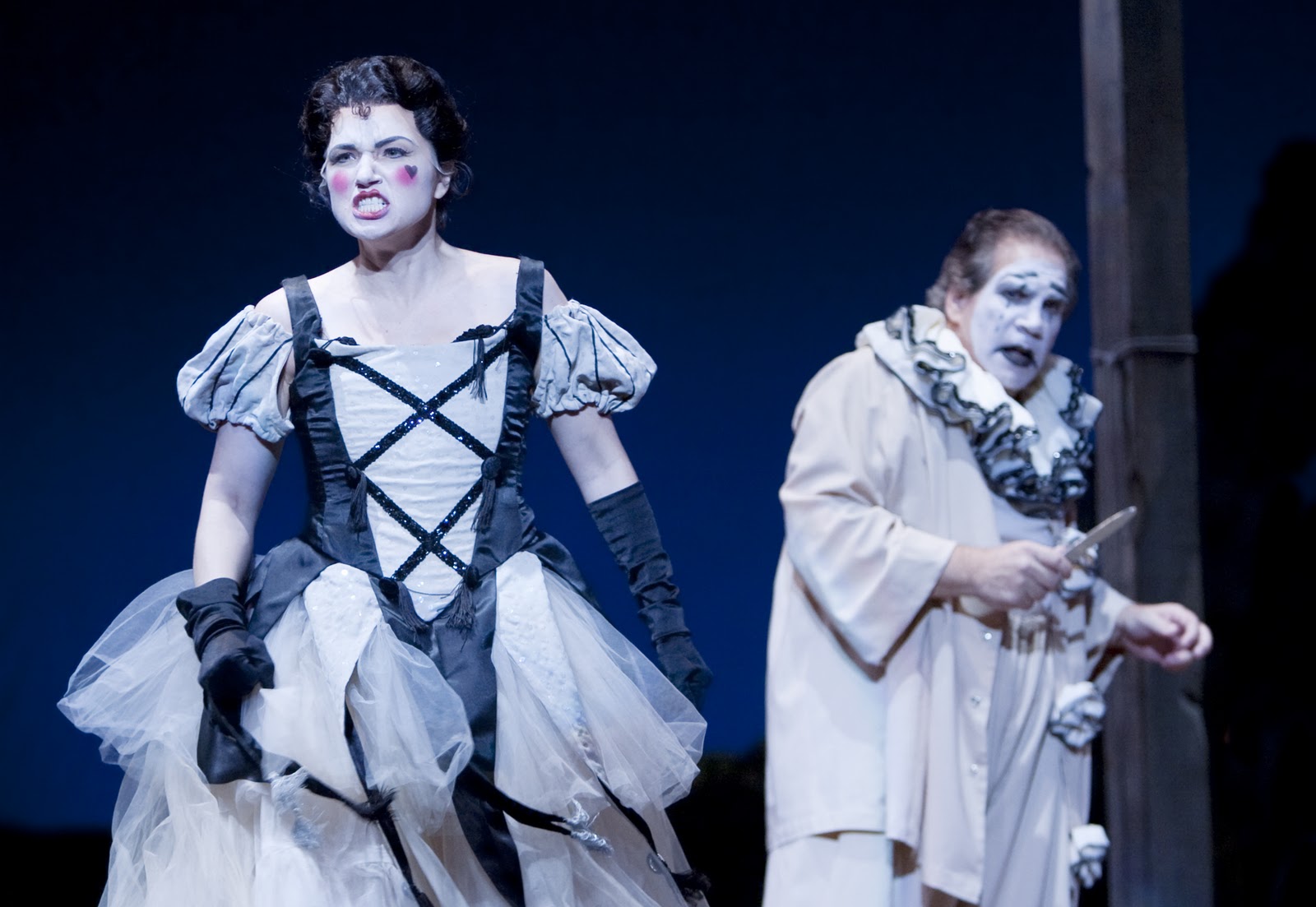
There's never a dull moment at the Metropolitan Opera. I've sung many roles there: the School Boy in "Lulu" (my debut), Prince Orlofsky, Cherubino, Nicklausse. And I've covered a couple of things, but I have never actually gone on stage as a cover at that house. On October 18th, all that changed.
At this point, I should explain a bit what a "cover" is. A "cover" is sort of an unofficial second cast. As a cover, you may not necessarily have scheduled performances, but you are "on call" for every one and must either be in the building or within a 20-minute cab ride of the Met, accessible by cell phone. You are responsible for learning the entire role and being present at every rehearsal, where you watch and carefully write down all of the stage directions. You also rehearse with the other covers and have a complete run-through before the day of the premiere, just in case something should happen to one of the first cast singers. I have to point out, though, that the covers have no stage or orchestra time. And although you have your own set of costumes, made just for you, you don't actually get a chance to rehearse in them. Bear this in mind as you read...
 So, I've been here at the Met these past two months, covering the role of Giovanna (Jane) Seymour in the new production of "Anna Bolena," which stars Anna Netrebko in the title role. I had been put on "official warning" for the three previous shows. The woman I was covering, Ekaterina Gubanova, had a sore throat and thought she was going to have to cancel, so I needed to be ready just in case. They had me in a dressing room with my costumes at the ready, but each time she wound up singing the entire performance.
On October 18th, I didn't get that "official warning," so I was covering from my cell phone and having dinner with a friend. Halfway through the show, I get The Call. After singing Act 1, my "coveree" felt she was losing her voice, had cancelled the rest of the show and I needed to get down there pronto. So I hopped into a cab, told the driver to step on it and arrived at the Met as fast as I could. They held the curtain for about 15 minutes while I was rushed into makeup and my costume (warming up while they're dressing me!). I was quickly swept into the 15th century and out onto the stage of the Met to sing the big Act 2 duet with Anna Netrebko. Keep in mind, I had never been on the set and had never sung this role with an orchestra. Oh, and this was a role debut for me as well. Anna was a wonderful colleague, energy was high and we had FUN out there. And then back I went into the dressing room to be rushed into the next costume--that beautiful reproduction of the red dress in the famous Holbein portrait of Jane Seymour--and onto the stage for my last big scene with Henry VIII and my aria.
I have to tell you that every single mezzo I've talked to who has sung this role has the same opinion of it: it's HARD. The role really lies in soprano territory and it's very difficult to maintain the tessitura and then end the aria on a high B. It is definitely the most technically-challenging role I have ever sung.
So there I am, on the stage of the Met, singing the most difficult aria I have ever sung, never having sung the aria in public before. Was I nervous? A bit but not as much as I had expected. There just wasn't time to be nervous! In the end, it all went very, very well, and I was pleased to have pulled it off.
And then... three days later, my "coveree" cancels again, but this time I had two hours' notice and sang the entire show. This also happened to be a live Sirius radio broadcast with a new soprano in the title role, Angela Meade. And again, the performance went very, very well.
So it turned out to be a very lucky week for me. This is why I always pick up lucky pennies. From never expecting I would actually perform this role, I wound up singing two performances, got a review (always good for the website), a radio broadcast AND there happened to be a house photographer there.
I should have bought a lottery ticket. But maybe that would've been pushing my luck just a little too far.
At this point, I should explain a bit what a "cover" is. A "cover" is sort of an unofficial second cast. As a cover, you may not necessarily have scheduled performances, but you are "on call" for every one and must either be in the building or within a 20-minute cab ride of the Met, accessible by cell phone. You are responsible for learning the entire role and being present at every rehearsal, where you watch and carefully write down all of the stage directions. You also rehearse with the other covers and have a complete run-through before the day of the premiere, just in case something should happen to one of the first cast singers. I have to point out, though, that the covers have no stage or orchestra time. And although you have your own set of costumes, made just for you, you don't actually get a chance to rehearse in them. Bear this in mind as you read...
 So, I've been here at the Met these past two months, covering the role of Giovanna (Jane) Seymour in the new production of "Anna Bolena," which stars Anna Netrebko in the title role. I had been put on "official warning" for the three previous shows. The woman I was covering, Ekaterina Gubanova, had a sore throat and thought she was going to have to cancel, so I needed to be ready just in case. They had me in a dressing room with my costumes at the ready, but each time she wound up singing the entire performance.
On October 18th, I didn't get that "official warning," so I was covering from my cell phone and having dinner with a friend. Halfway through the show, I get The Call. After singing Act 1, my "coveree" felt she was losing her voice, had cancelled the rest of the show and I needed to get down there pronto. So I hopped into a cab, told the driver to step on it and arrived at the Met as fast as I could. They held the curtain for about 15 minutes while I was rushed into makeup and my costume (warming up while they're dressing me!). I was quickly swept into the 15th century and out onto the stage of the Met to sing the big Act 2 duet with Anna Netrebko. Keep in mind, I had never been on the set and had never sung this role with an orchestra. Oh, and this was a role debut for me as well. Anna was a wonderful colleague, energy was high and we had FUN out there. And then back I went into the dressing room to be rushed into the next costume--that beautiful reproduction of the red dress in the famous Holbein portrait of Jane Seymour--and onto the stage for my last big scene with Henry VIII and my aria.
I have to tell you that every single mezzo I've talked to who has sung this role has the same opinion of it: it's HARD. The role really lies in soprano territory and it's very difficult to maintain the tessitura and then end the aria on a high B. It is definitely the most technically-challenging role I have ever sung.
So there I am, on the stage of the Met, singing the most difficult aria I have ever sung, never having sung the aria in public before. Was I nervous? A bit but not as much as I had expected. There just wasn't time to be nervous! In the end, it all went very, very well, and I was pleased to have pulled it off.
And then... three days later, my "coveree" cancels again, but this time I had two hours' notice and sang the entire show. This also happened to be a live Sirius radio broadcast with a new soprano in the title role, Angela Meade. And again, the performance went very, very well.
So it turned out to be a very lucky week for me. This is why I always pick up lucky pennies. From never expecting I would actually perform this role, I wound up singing two performances, got a review (always good for the website), a radio broadcast AND there happened to be a house photographer there.
I should have bought a lottery ticket. But maybe that would've been pushing my luck just a little too far.